Visualisation of a smart grid's reliability optimization

A variable neighborhood search simheuristic algorithm for reliability optimization of smart grids under uncertainty

To prevent long-term damage from cable overloads when user curtailment is insufficient, the authors propose a single-stage stochastic program to optimize smart grid topology reconfiguration under uncertain future energy demands. Their approach uses a Unified Overload Index to evaluate expected grid reliability and employs a simheuristic algorithm based on Variable Neighborhood Search—enhanced with variance reduction techniques—to efficiently solve the computationally intensive optimization problem. Evaluated using real-world data from a Luxembourg grid operator, the proposed method rapidly identifies robust countermeasures that minimize user disturbances and ensure the smart grid’s stability for the following day.


27 Sep 2021 · Nikolaos Antoniadis, Maxime Cordy, Angelo Sifaleras, Yves Le Traon
Enhancing Smart Grid Resilience and Reliability: A multifaceted approach to overload prevention

Enhancing Smart Grid Resilience and Reliability by Using and Combining Simulation and Optimization Methods

First, the author models the deterministic overloading prevention problem using a combinatorial optimization approach to suggest immediate reconfiguration actions, such as load curtailment or fuse switching, when an overload is imminent. Second, the research addresses future uncertainties by employing Monte Carlo Simulation and a simheuristic algorithm to evaluate and optimize the grid’s stability over a planning horizon. Finally, the dissertation introduces a machine learning monitoring system utilizing ND-trees to learn smart meter failure patterns, which helps operators accurately distinguish between harmless communication disruptions and critical grid issues.

27 May 2021 · Nikolaos Antoniadis
Smart grid low-voltage overloading prevention: a schematic visualization

Preventing Overloading Incidents on Smart Grids: A Multiobjective Combinatorial Optimization Approach

The authors formulate the overloading prevention problem as a Multiobjective Mixed Integer Quadratically Constrained Program that aims to maximize the number of connected users while minimizing physical cabinet visits and fuse alterations. By employing a state-of-the-art exact mathematical solver, the method calculates the most appropriate combination of remotely curtailing user power and physically switching grid fuses. Evaluations based on real-world data from a Luxembourg grid operator demonstrate that this automated approach rapidly suggests optimal countermeasures, significantly reducing the need to completely disconnect users during potential overloads.

15 Feb 2020 · Nikolaos Antoniadis, Maxime Cordy, Angelo Sifaleras, Yves Le Traon
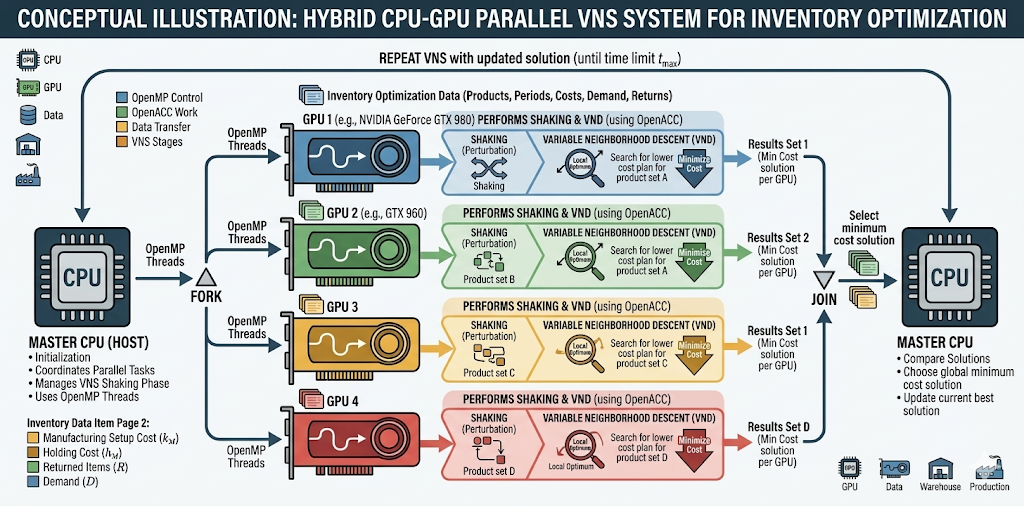
A hybrid CPU-GPU parallelization scheme

A hybrid CPU-GPU parallelization scheme of variable neighborhood search for inventory optimization problems

The authors address the computationally demanding uncapacitated multi-item economic lot-sizing problem with remanufacturing by developing parallel versions of the General Variable Neighborhood Search (GVNS) algorithm. Through an experimental comparison of serial, OpenMP, OpenACC, and hybrid CPU-GPU implementations, the study shows that parallelizing the algorithm significantly improves the quality of the solutions found within a given time limit. Specifically, the hybrid OpenMP-OpenACC scheme slightly outperformed the other methods, demonstrating the practical advantages of leveraging both CPU threads and GPU hardware for heuristic performance tuning.

17 Apr 2017 · Nikolaos Antoniadis, Angelo Sifaleras
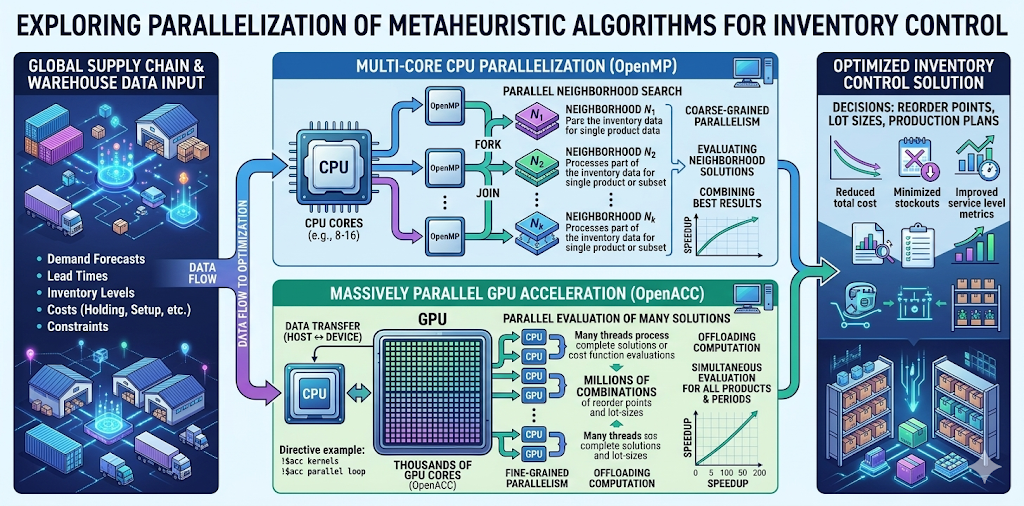
Exploring parallelization of Metaheuristics for Inventory Control Problems

Parallelization of a metaheuristic algorithm for complex inventory management and control problems: A computational study using OpenMP and OpenACC technologies

The author explores the theoretical background of metaheuristics, specifically Variable Neighborhood Search (VNS), alongside parallel programming architectures before implementing a parallelized Variable Neighborhood Descent (VND) algorithm for a multi-product dynamic lot-sizing problem. Computational experiments reveal that both OpenMP and OpenACC significantly reduce execution time, achieving a speedup of approximately 3.3 times over the serial version. However, because the applied parallelization strategy focused strictly on accelerating computations rather than expanding the search space, the overall quality of the final solutions remained unchanged.

20 Jun 2016 · Nikolaos Antoniadis